Driver Health Analytics: From Raw Data to Actionable Alerts
Research-driven analysis of driver health analytics actionable alerts, from in-cabin physiological signals to fleet workflows that reduce fatigue and medical-event risk.
Driver Health Analytics: From Raw Data to Actionable Alerts
For automotive OEMs, Tier-1 suppliers, and fleet operators, the real challenge is no longer collecting driver data. Cabin cameras, driver monitoring systems, telematics stacks, and edge processors already generate enormous volumes of it. The hard part is turning those signals into driver health analytics actionable alerts that safety teams can actually trust and use. A raw heart-rate trace, a blink-duration trend, or a fatigue score on its own does not change driver behavior. An alert tied to context, confidence, escalation logic, and operational response just might.
"Heart rate and skin conductance level both increased significantly with each incremental increase in cognitive demand." — Bruce Mehler, Bryan Reimer, and Joseph F. Coughlin, MIT AgeLab on-road study (2012)
Driver Health Analytics Actionable Alerts Start With Signal Quality
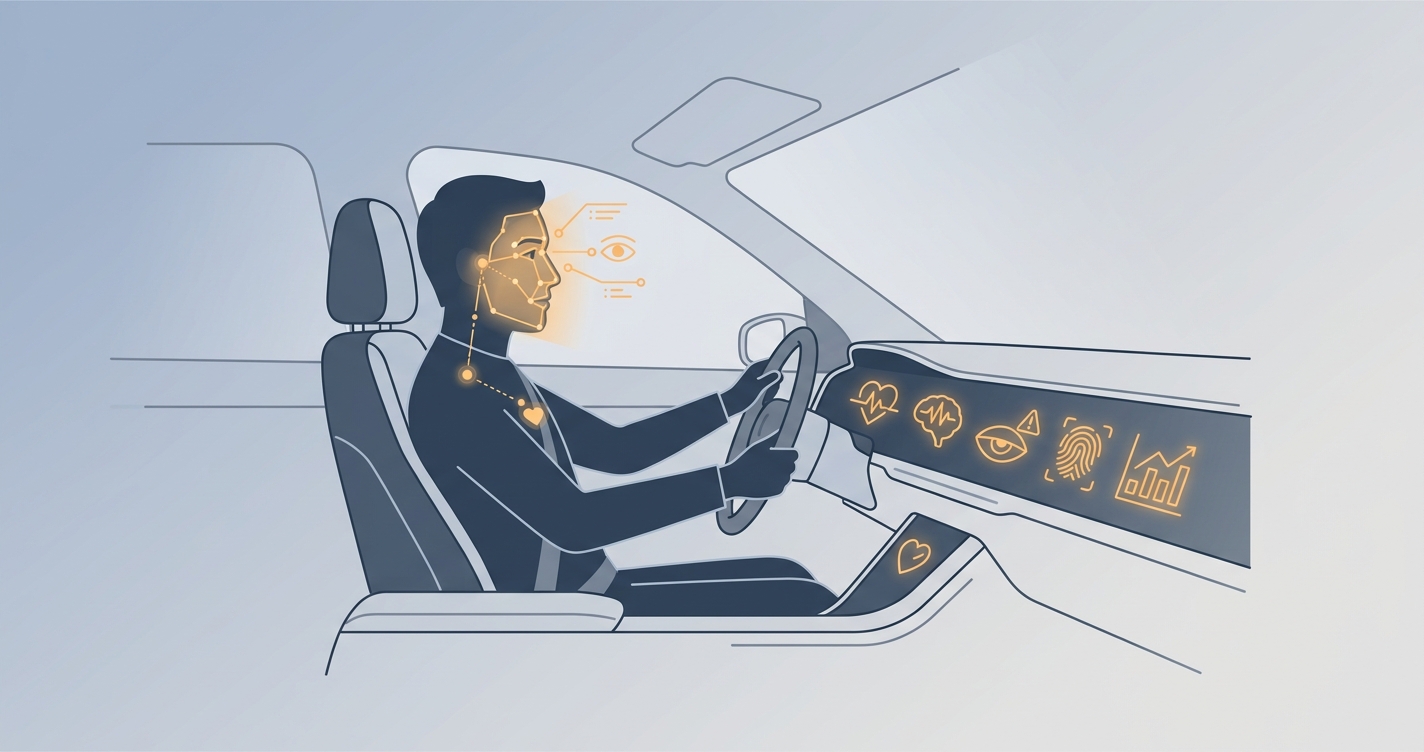
The driver-health analytics stack usually begins with contactless sensing inside the cabin: camera-based remote photoplethysmography (rPPG), conventional DMS vision models, and sometimes radar or seat-based sensing. But actionable alerts depend less on how much data is collected than on whether the system can classify physiological change in a way that maps to a real operational decision.
A 2023 paper by Qin Duan, Xiaosong Liu, Jinchao Xiao, Li Wang, and Jingfeng Yang proposed a multimodal driver-physiology monitoring framework that combined biometric recognition with heart-rate, breathing-frequency, emotion, and fatigue analysis. Their work is useful because it frames the problem correctly: the goal is not just measurement, but continuous interpretation of multiple signals at once.
That matters in fleet operations. A high heart rate by itself might mean stress, caffeine, heat load, or simply a demanding traffic segment. A declining heart-rate-variability pattern combined with prolonged blink duration, lane instability, and time-on-task looks very different. Good alerting systems treat physiology as part of a larger decision layer.
Comparison of driver-health analytics approaches
| Approach | Primary inputs | What it detects well | Main weakness | Best alert type |
|---|---|---|---|---|
| Camera-based rPPG + DMS | Heart rate, HRV proxies, blink patterns, gaze, head pose | Fatigue buildup, stress response, attention decline | Motion and lighting artifacts need filtering | Early warning + escalating fatigue alerts |
| Wearable biosensors | HR, HRV, skin temperature, motion | High-fidelity physiology for a single driver | Compliance drops in real fleets | Personalized health-risk alerts |
| Telematics-only scoring | Harsh braking, speeding, lane events, route context | Risky driving behavior after it appears | Weak physiological insight | Coaching alerts and manager review |
| Radar / seat sensing | Respiration, heart motion, posture | Redundant occupancy and medical-event support | Added hardware complexity | Silent verification + emergency escalation |
| Rules-only thresholding | Pre-set numeric limits | Simple implementation | High false positives, low nuance | Basic exception alerts only |
The pattern is pretty clear. Systems become more useful when they fuse physiological and behavioral data, and less useful when they depend on a single threshold that ignores context.
Why Fleet Teams Need Alerts, Not Dashboards
Fleet safety teams rarely fail because they lack dashboards. They fail because they get dashboards instead of workflows.
The AAA Foundation for Traffic Safety reported in 2018 that drowsy driving was involved in 9.5% of all crashes and 10.8% of crashes involving significant property damage, airbag deployment, or injury. The study, based on large-scale naturalistic driving data, also noted that sleep loss of just two to three hours can more than quadruple crash risk. Those numbers are large enough to justify monitoring, but they do not tell a fleet manager what to do at 2:17 a.m. when a driver on a long-haul route begins to deteriorate physiologically.
That is where alert design becomes the product.
Useful driver-health analytics systems usually translate raw data into three operational layers:
- Trend detection — Is the driver drifting away from baseline over the last 10 to 30 minutes?
- Immediate intervention — Does the driver need an in-cabin warning, break recommendation, or route change now?
- Escalation logic — Does this event belong only to the driver, or should it also reach dispatch, a safety manager, or emergency services?
This sounds obvious, but many systems stop at the first layer. They detect something statistically interesting, then leave humans to decide what it means. In practice, that creates alert fatigue. Safety teams stop responding because too many events lack urgency, context, or next-step guidance.
Industry Applications for Driver Health Analytics
Long-haul trucking
Long-haul environments are where driver health analytics turns from a lab concept into an operations problem. Time-on-task, night driving, circadian disruption, and route monotony all raise fatigue risk. In this setting, early alerts are more valuable than dramatic alerts. By the time the driver is nodding or weaving, the intervention window is already narrowing.
Research on heart-rate variability has been central here. A 2011 study by Patel, Lal, Kavanagh, and Rossiter applied neural-network analysis to HRV data for driver-fatigue assessment and reported about 90% classification accuracy in laboratory testing. The exact deployment environment matters, of course, but the broader takeaway remains important: physiological change can be detected before an obvious behavioral failure shows up.
Delivery and route-dense fleets
Last-mile fleets create a different pattern. Less monotony, more stop-start stress. For these operators, actionable alerts often focus less on slow fatigue accumulation and more on cognitive overload, time pressure, and escalating stress during dense urban operations.
McKinsey has argued that telematics and connected fleet platforms can materially reduce preventable accidents by identifying and managing risky behavior earlier. That logic becomes stronger when physiological data is layered in. Harsh braking after a long route is one thing; harsh braking during a period of elevated stress and sustained workload is a much more useful signal.
Automotive OEM and Tier-1 programs
For OEMs, driver-health analytics is increasingly about architecture. Euro NCAP's 2026 protocol direction pushes occupant and driver monitoring toward more adaptive in-cabin intelligence rather than one-dimensional gaze checks. A cabin stack that can classify driver state, prioritize alerts, and support safety interventions fits that trajectory better than a camera feed that only flags eyelid closure.
Current Research and Evidence
Several research threads explain why this category is gaining traction.
First, Bruce Mehler, Bryan Reimer, and Joseph F. Coughlin at MIT AgeLab showed in their 2012 on-road study that heart rate and skin conductance rose with increasing cognitive demand across 108 drivers. That matters because actionable alerts should not wait for obvious failure states; they should catch rising workload before performance visibly collapses.
Second, the AAA Foundation's 2018 drowsy-driving prevalence work showed that fatigue-related crash involvement is likely undercounted in conventional reporting. If fatigue is systematically underdetected after crashes, pre-crash monitoring becomes more valuable, not less.
Third, the National Highway Traffic Safety Administration reported in its 2015 analysis of the National Motor Vehicle Crash Causation Survey that driver-related critical reasons were present in 94% of crashes studied. NHTSA is careful to note that this does not assign blame. Still, for product teams building alerting systems, it is a reminder that the driver's state remains central to crash prevention.
Fourth, Qin Duan and colleagues' multimodal monitoring work reinforces the idea that no single sensor should carry the whole burden. Driver state is messy. Systems that combine physiological and behavioral signals are usually better positioned to issue fewer, sharper alerts.
- Raw data alone does not reduce crashes.
- Fused signals outperform isolated metrics.
- Context matters as much as detection.
- Alerts must map to a real workflow.
- Escalation design is part of the safety system, not an afterthought.
The Future of Driver Health Analytics
The next phase of the category will likely be less about adding more sensors and more about improving decision quality.
One shift is toward personal baselining. A heart rate of 92 bpm may be routine for one driver and abnormal for another. Analytics systems that learn normal range, route conditions, and shift context can suppress noise and reserve alerts for genuine deterioration.
Another shift is toward graded alerting. Not every event deserves the same response. Future systems will probably separate advisory alerts, mandatory intervention alerts, and emergency-response alerts with clearer confidence scoring and supporting evidence.
A third shift is toward edge-side interpretation. In automotive environments, latency and privacy matter. Processing cabin signals on-device and sending only event summaries upstream gives OEMs and fleets a cleaner path for compliance and lower-bandwidth deployment.
There is also a hard business reason this will continue. The National Safety Council estimates that motor-vehicle crashes create enormous economic burden, with 2023 societal costs topping $559.3 billion. Even modest improvements in fatigue mitigation, incident prevention, and response timing can have a meaningful operational payoff for fleets and insurers.
Frequently Asked Questions
What makes a driver-health alert actionable?
An actionable alert includes more than a score. It should identify the likely risk state, confidence level, recommended response, and who needs to receive it. If the system cannot tell the operator what to do next, it is reporting data, not creating an alert.
Which signals are most useful for driver health analytics?
The most useful systems combine physiological signals such as heart rate and HRV proxies with behavioral features like blink duration, gaze direction, head pose, and driving context. Multimodal systems usually outperform single-metric systems because they reduce ambiguity.
How do fleets avoid alert fatigue?
They avoid it by using thresholds tied to route context, time-on-task, and baseline behavior rather than firing on every anomaly. Tiered escalation and quiet verification layers also help keep the most disruptive alerts for the highest-confidence events.
Are driver-health analytics only for commercial fleets?
No. The same logic matters for OEM passenger vehicles, especially as Euro NCAP and broader in-cabin safety expectations evolve. Commercial fleets just feel the ROI first because the operational and insurance consequences are immediate.
Solutions like Circadify are part of this shift toward contactless in-cabin sensing that can turn physiological signals into usable safety workflows. For more background, see How In-Cabin Vital Signs Monitoring Improves Road Safety and How Fleet Operators Use Driver Health Monitoring Systems.