
Driver Monitoring System Regulations: Global Overview for 2026
A research-focused overview of driver monitoring system regulations global 2026, covering Euro NCAP, EU rules, UNECE policy, China NCAP, Japan, and the U.S. outlook.
Driver Monitoring System Regulations: Global Overview for 2026
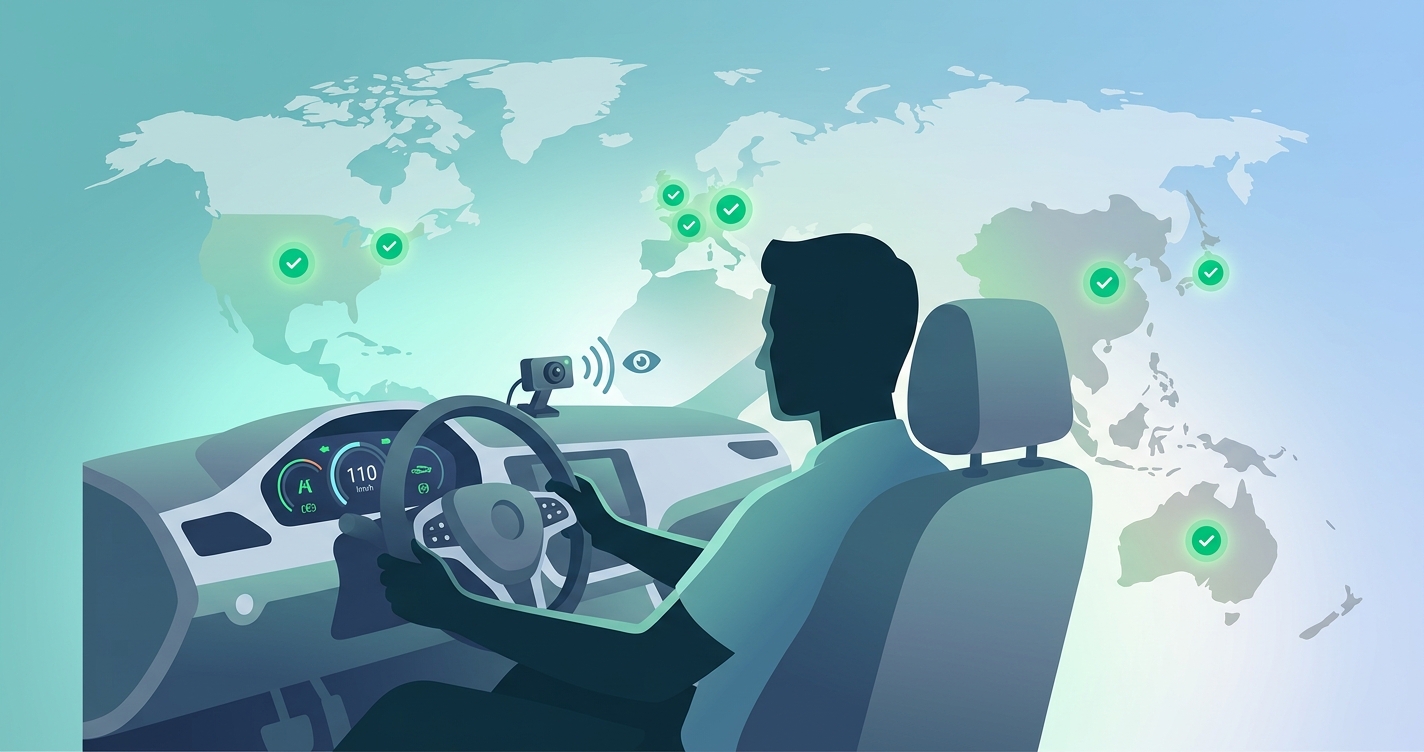
By 2026, driver monitoring has moved out of the R&D lab and into the rulebook. For OEMs, Tier-1 suppliers, and fleet technology teams, driver monitoring system regulations global 2026 is no longer a niche compliance question. It now touches safety ratings, automated-driving approvals, distracted-driving countermeasures, and platform planning across Europe, China, Japan, and the United States. The hard part is that the market is not following one clean global standard. It is a patchwork of mandates, NCAP scoring changes, and emerging automated-driving rules that all push in the same direction: continuous observation of driver readiness.
"To achieve a 5-star rating, vehicles will need advanced Driver State Monitoring systems that continuously track eye and head movements to detect distraction, impairment, and unresponsiveness." — European Transport Safety Council summary of Euro NCAP's 2026 protocol update
Driver monitoring system regulations in 2026: what is actually changing?
The most important shift is simple. Regulators are moving away from indirect proxies like steering behavior alone and toward direct observation of the driver.
In Europe, Regulation (EU) 2019/2144, usually called the General Safety Regulation, established the legal framework for driver drowsiness and attention warning functions. That rule put driver-state sensing on the mandatory safety roadmap for new vehicles. On top of that legal baseline, Euro NCAP's 2026 protocol raises the commercial stakes. A supplier can meet minimum legal requirements and still fall short of what product teams need for a five-star result.
UNECE's Driver Control Assistance Systems (DCAS) work adds another layer. The focus there is not only drowsiness. It is also takeover readiness and the problem every Level 2 system faces: how do you prove the driver is still engaged when the car is doing more of the driving?
China is moving through NCAP and assisted-driving policy rather than copying Europe's exact path. Global NCAP's summary of the 2024 C-NCAP update notes that DMS is now part of rated safety performance, with direct scoring tied to fatigue and attention monitoring scenarios. That matters because Chinese policy often moves from assessment pressure into faster production adoption.
The United States still looks different. NHTSA's 2023 advance notice of proposed rulemaking on advanced impaired driving prevention technology does not amount to a camera-based DMS mandate today. Still, it signals where federal thinking is headed: passive systems that can identify impairment, distraction, or drowsiness before the vehicle keeps moving.
Global regulatory picture at a glance
| Region | Main framework in force or development | What regulators are pushing for | 2026 implication |
|---|---|---|---|
| European Union | General Safety Regulation (EU) 2019/2144 | Driver drowsiness and attention warning as baseline safety functionality | DMS becomes standard platform planning, not premium trim add-on |
| Euro NCAP | 2026 protocol update | Eye/head tracking, impairment and unresponsiveness detection for top ratings | Higher bar than bare legal compliance |
| UNECE | DCAS and automated-driving rules | Direct driver engagement checks for assisted driving handoff | More pressure on robust camera-based monitoring |
| China | C-NCAP 2024 and emerging assisted-driving rules | Fatigue and attention monitoring tied to safety scoring | Faster validation demand for local and export programs |
| Japan | Automated operation and ADAS safety guidance | Monitoring driver condition and takeover readiness | DMS remains central for automated-operation acceptance |
| United States | NHTSA impaired-driving rulemaking | Passive monitoring for impairment, distraction, or drowsiness | No universal mandate yet, but architecture decisions are moving now |
A lot of teams still ask whether 2026 is the year of one global DMS law. It isn't. It is the year when ignoring DMS starts to look irresponsible in product planning.
Why camera-based monitoring is becoming the default compliance path
Regulators and safety programs keep returning to the same problem: they want evidence that the driver is actually available to drive. Steering-wheel torque and lane-keeping behavior can help, but they are weak substitutes for direct observation.
That is why camera-based systems keep winning the architectural argument.
- They can measure gaze direction, eyelid closure, blink duration, and head pose.
- They support distraction and drowsiness detection in a way steering-only signals cannot.
- They fit automated-driving handoff requirements better than passive vehicle-dynamics inference.
- They can share hardware with broader in-cabin sensing programs.
This does not mean every jurisdiction explicitly mandates one camera design. It means the combination of legal requirements, NCAP incentives, and automation rules keeps narrowing the practical options.
Comparison of major compliance approaches
| Approach | What it measures | Strengths | Limits in 2026 compliance context |
|---|---|---|---|
| Camera-based DMS | Eyes, face, gaze, head pose, eyelid closure | Direct observation of attention and drowsiness | Requires cabin placement, IR performance, and privacy governance |
| Steering-based monitoring | Torque input, micro-corrections | Cheap and already integrated in many platforms | Weak for distraction, poor for takeover-readiness proof |
| Seat or wheel biosensing | Contact-based physiology | Can add fatigue context | Adoption and integration complexity remain high |
| Multi-sensor fusion | Camera plus vehicle and cabin signals | Best overall robustness | Higher validation and cost burden |
Industry applications by market segment
Passenger vehicle OEMs
For passenger cars in Europe, the commercial target is often not mere legality. It is legal compliance plus a strong NCAP result. That means DMS programs now sit inside safety, cockpit electronics, HMI, and software-validation workstreams at the same time.
Tier-1 suppliers
Tier-1s are under pressure to offer reusable DMS stacks that can survive market differences. One OEM may want a Euro NCAP-ready attention stack. Another may prioritize Chinese validation scenarios. A third may be planning for driver-engagement logic in a Level 2+ feature set.
Fleet and commercial vehicle operators
Fleets do not always face the same consumer-star-rating pressure, but they care a lot about fatigue, incident reduction, and defensible safety policy. Regulations aimed at distraction and impairment still change what fleet buyers ask for in RFQs.
Automated-driving programs
This is where the regulation story gets more demanding. A DMS is not just a warning device anymore. It becomes part of the argument that the human fallback driver can take control when asked.
Current research and evidence
The regulatory push is backed by a long research trail. The rules did not appear out of nowhere.
Virginia Tech Transportation Institute researchers Wierwille and Ellsworth helped establish PERCLOS in the 1990s as a useful camera-based indicator of drowsiness. That work still matters because many production systems rely on eyelid-closure behavior as a core fatigue signal.
Eriksson and Stanton at the University of Southampton showed in 2017 that takeover times in automated driving vary widely depending on how engaged the driver is before the request. That finding helps explain why regulators no longer trust coarse engagement proxies.
Mary Lesch and colleagues at NHTSA, along with related human-factors work cited in federal distracted-driving discussions, pushed the field toward direct observation of visual attention rather than waiting for the vehicle to drift first. The same logic shows up again in today's NCAP and DCAS language.
Recent policy and industry summaries reinforce that research trend:
- The European Transport Safety Council's 2025 summary of Euro NCAP's 2026 protocols describes DSM as necessary for detecting distraction, impairment, and unresponsiveness.
- UNECE's DCAS materials center on ensuring that assisted-driving systems can confirm driver engagement and readiness to intervene.
- Global NCAP's overview of C-NCAP 2024 describes DMS as a scored element of proactive vehicle safety in China.
- NHTSA's 2023 ANPRM on impaired driving prevention technology asks how passive systems could detect alcohol impairment, drowsiness, and distraction.
Selected research and policy references
| Source | Institution | Why it matters |
|---|---|---|
| Wierwille and Ellsworth (1994) | Virginia Tech Transportation Institute | Helped establish camera-measurable eyelid metrics for drowsiness detection |
| Eriksson and Stanton (2017) | University of Southampton | Showed that takeover quality depends heavily on driver state before handoff |
| Regulation (EU) 2019/2144 | European Union | Put drowsiness and attention warning into the legal vehicle-safety framework |
| Euro NCAP 2026 protocol summary (ETSC, 2025) | ETSC / Euro NCAP ecosystem | Raised expectations for top safety ratings beyond minimum compliance |
| C-NCAP 2024 summary (Global NCAP) | Global NCAP / Chinese safety ecosystem | Confirmed DMS as a scored safety topic in China |
| NHTSA ANPRM (2023) | U.S. Department of Transportation | Shows U.S. rulemaking interest in passive impairment and distraction prevention |
The future of driver monitoring regulation
The near future looks less like one universal law and more like convergence through pressure from several directions.
First, NCAP programs are doing some of the work that legislation has not finished yet. Second, automated-driving rules are making driver readiness a system-level requirement instead of a convenience feature. Third, regional markets are treating in-cabin sensing as part of active safety rather than infotainment.
By the end of this decade, the interesting question probably will not be whether DMS is required. It will be which capabilities are required, how they are validated, and how privacy, edge processing, and event logging are governed across markets.
For engineering teams, that changes the roadmap now:
- Build for multi-market validation from the start.
- Expect Euro NCAP and legal compliance to diverge.
- Treat DMS as part of ADAS safety architecture, not a standalone camera app.
- Design data handling carefully, because privacy scrutiny is only going up.
Frequently asked questions
Is there one global driver monitoring law for 2026?
No. There is no single worldwide DMS law. Instead, 2026 brings a mix of EU safety rules, Euro NCAP scoring changes, UNECE automated-driving requirements, Chinese NCAP pressure, Japanese automated-operation expectations, and U.S. rulemaking activity.
Does 2026 matter more for law or for safety ratings?
Both, but safety ratings matter more than many teams expect. In Europe especially, Euro NCAP's 2026 changes raise the bar beyond minimum legal compliance, which can directly affect vehicle positioning and buyer perception.
Why are cameras favored over steering-based driver monitoring?
Because they observe the driver directly. Gaze direction, blink behavior, and head pose provide stronger evidence of distraction or drowsiness than steering behavior alone.
What should suppliers do first if they sell across multiple regions?
Start with a requirements map that separates legal obligations, NCAP scoring needs, and automated-driving program demands. They overlap, but they are not identical.
A lot of companies are still treating DMS as a feature discussion. It has become a platform decision. If your team is planning in-cabin sensing, fatigue monitoring, or driver-readiness logic for a future vehicle program, solutions like Circadify's automotive cabin work are aimed at that exact problem: turning contactless sensing into hardware and software that fit real automotive validation paths. For related context, see our earlier analyses on Euro NCAP driver monitoring requirements and how drowsiness detection systems read vital signs.