The Future of In-Cabin Health: Beyond Fatigue Detection
A research-based look at future in cabin health beyond fatigue, from stress and vital-sign sensing to unresponsive-driver intervention and smarter cabin safety systems.
The Future of In-Cabin Health: Beyond Fatigue Detection
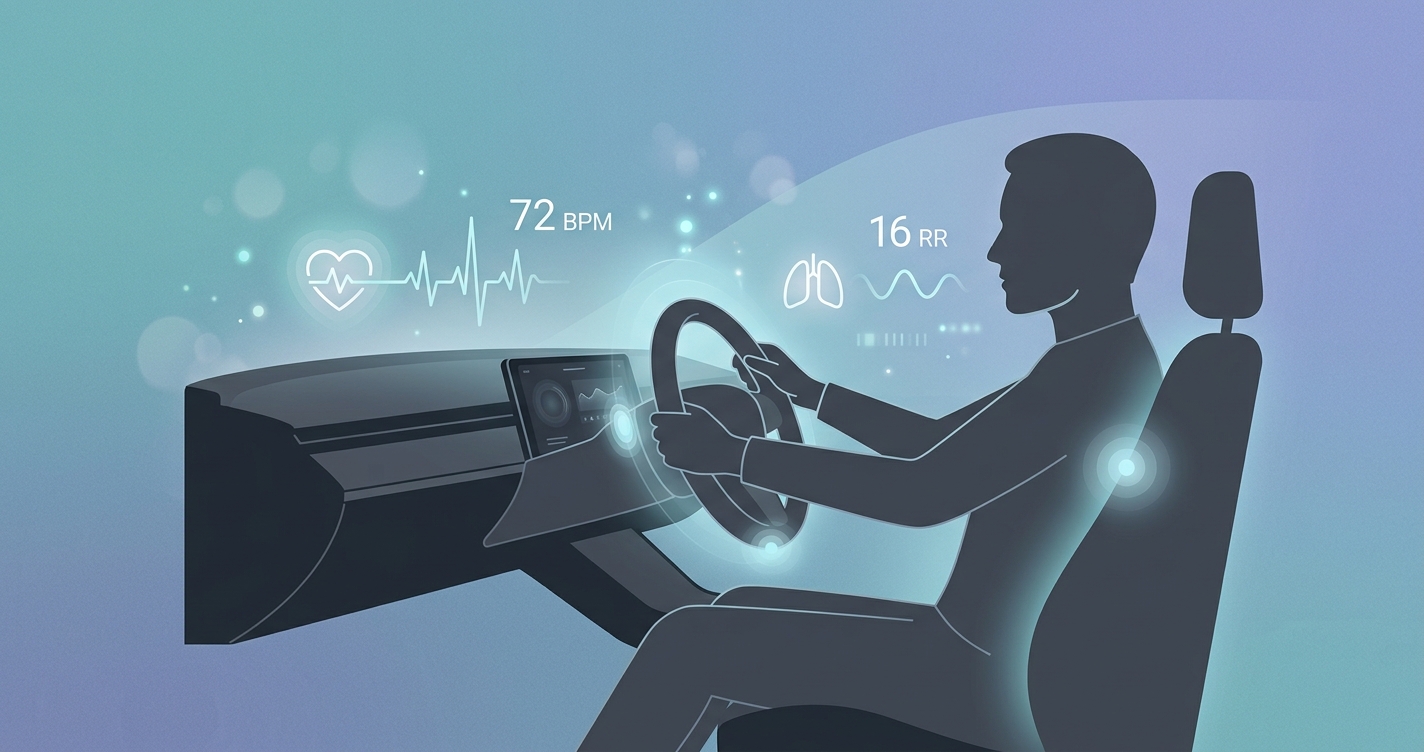
The future in cabin health beyond fatigue is starting to look much broader than a camera that checks whether a driver is sleepy. For OEMs, Tier-1 suppliers, and fleet safety teams, the next question is whether the cabin can become a real-time health layer: one that spots stress, tracks breathing, detects unresponsiveness, and gives assisted-driving systems a better read on whether the human in the seat is actually able to respond. Fatigue detection is still the baseline. It just is not the whole story anymore.
"The 2026 protocols significantly increase the scoring weight for Driver Monitoring Systems, making direct driver monitoring a full scoring category worth up to 25 points." — Euro NCAP driver monitoring overview, 2026 test approach
Future in-cabin health beyond fatigue starts with a wider definition of driver state
The first generation of automotive driver monitoring mostly focused on visible signs of drowsiness: blinking, eyelid closure, gaze direction, head pose, and long off-road glances. That work remains important, and Euro NCAP's distraction and unresponsiveness criteria still reward systems that can detect those behaviors reliably. But the cabin technology stack is getting more ambitious.
A 2024 review, Recent Advances in Vehicle Driver Health Monitoring Systems, describes the field as a shift toward multi-sensor monitoring of driver condition rather than simple alertness checks. At the same time, Analog Devices' in-cabin sensing analysis argues that cabin systems are moving toward sensor fusion, where cameras, depth sensing, and radar combine to understand both safety risk and occupant condition.
That matters because a real in-cabin health system may need to answer several different questions at once:
- Is the driver attentive?
- Is the driver drowsy or cognitively overloaded?
- Is there evidence of stress or abnormal breathing?
- Has the driver become unresponsive?
- Should the vehicle change its warnings, comfort settings, or fallback behavior?
Those are different jobs. The future stack will probably treat them that way.
How the cabin health stack is expanding
| Capability layer | What earlier DMS focused on | What newer in-cabin health systems are adding | Why it matters |
|---|---|---|---|
| Attention monitoring | Gaze, blink rate, head pose | Engagement scoring tied to ADAS behavior | Better takeover logic in assisted driving |
| Fatigue detection | PERCLOS, microsleep cues, yawning | Multimodal fatigue estimation with physiology | Earlier detection than behavior alone |
| Stress and workload | Usually absent | Heart rate, breathing patterns, stress inference where sensors support it | Helps explain driver condition before visible failure |
| Medical-event response | Rare | Unresponsive-driver detection and safe-stop logic | Important for emergency scenarios |
| Occupant health context | Minimal | Full-cabin sensing for posture, child presence, and occupant state | Moves cabin sensing beyond the driver seat |
The next step is stress, respiration, and vital-sign context
This is where the conversation gets more interesting. Once a cabin camera is already installed for driver monitoring, suppliers naturally start asking whether it can do more. Remote photoplethysmography, or rPPG, is one path. Camera-based systems can estimate pulse and sometimes breathing-related patterns by analyzing subtle changes in facial reflectance. In practice, automotive conditions are harder than a controlled clinical room, but the engineering direction is clear.
A 2024 OMNIVISION and Philips announcement is worth watching for that reason. Their joint prototype for in-cabin driver health monitoring combines an RGB-IR automotive image sensor with Philips vital-sign camera software to measure pulse and breathing rate inside the vehicle. The companies positioned it not as a novelty feature, but as a way to support adaptive comfort, route suggestions, and safety-related interventions.
I think that tells you where the market is going. Cabin health is becoming less about a single warning buzzer and more about adding physiological context to the whole interior sensing system.
The strongest near-term applications are pretty practical:
- Breathing-rate changes that may signal fatigue, stress, or distress
- Heart-rate trends that may support workload or readiness models
- Context-aware break suggestions for long-haul or commercial operations
- Better distinction between distraction, exhaustion, and genuine medical risk
- Stronger support for unresponsive-driver intervention workflows
That does not mean every production program will expose a dashboard full of health metrics. Most will not. But the sensing pipeline underneath is moving that way.
Industry applications for broader in-cabin health monitoring
Passenger vehicles with assisted driving
For passenger cars with Level 2 and higher assisted-driving features, the most immediate value is improved confidence management. Euro NCAP's 2026 framework explicitly rewards direct driver monitoring, eye and head tracking, and systems that can recognize unresponsiveness and link driver state to vehicle response. In plain language: the vehicle should not treat an alert driver and an incapacitated driver the same way.
That makes broader in-cabin health sensing useful even when the public-facing feature is still framed as distraction monitoring. If the cabin stack can tell the difference between ordinary inattention, escalating drowsiness, and a possible medical issue, the HMI and fallback logic can become more intelligent.
Commercial fleets and long-haul operations
Fleet buyers usually care less about futuristic personalization and more about preventing bad outcomes. A broader health-monitoring layer can help them separate three problems that often get lumped together: fatigue, stress, and medical distress.
That distinction matters in trucking, transit, mining, and other high-duty-cycle operations. A driver who is tense and overloaded is not the same as a driver drifting toward sleep. A driver who is suddenly unresponsive is a different case again. Better cabin health sensing can give safety teams cleaner event categories and more useful escalation logic.
Premium cabins and comfort personalization
Not every application is about crisis detection. Analog Devices notes that in-cabin sensing is also being developed for biometric authentication, adaptive settings, gesture control, and occupant comfort. If vital-sign sensing matures in production cabins, the same stack could eventually support quieter features such as climate changes, seat adjustments, or route prompts when the system detects rising stress or abnormal occupant condition.
That side of the market matters because comfort budgets often help fund safety hardware.
Current Research and Evidence
The evidence base behind this shift comes from both regulation and system design.
Euro NCAP's driver monitoring overview says that from 2026, top-scoring vehicles will need continuous eye- and head-tracking, stronger linkage between driver state and assistance systems, and extra capability for impairment and unresponsive-driver scenarios. Its distraction and unresponsiveness guidance gets more specific: long distraction, cumulative distraction, and gaze-away timing thresholds all matter, and vehicles can earn more credit if they move from warnings toward intervention.
The 2024 Recent Advances in Vehicle Driver Health Monitoring Systems review frames modern driver health monitoring as a convergence of imaging, physiological sensing, and AI-based interpretation. That is useful because it moves the topic out of the narrow "fatigue camera" box. The review treats driver condition as a broader health-monitoring problem that can include heart-related, respiratory, and behavior-linked indicators.
Analog Devices makes a similar argument from the hardware side. Its in-cabin sensing analysis points to sensor fusion between cameras and radar, especially for occupant monitoring and safety-critical cases where a single sensor has blind spots. Radar can help with breathing-related detection and cabin coverage when visibility is poor, while vision provides the behavioral context radar cannot.
The OMNIVISION-Philips prototype adds a more commercial signal. It suggests that suppliers now see in-cabin pulse and breathing measurement as close enough to real product planning that they are demonstrating automotive-ready integrations rather than just research papers.
Sources shaping the next generation of cabin health systems
| Source | Organization or authors | What it adds |
|---|---|---|
| Euro NCAP driver monitoring overview (2026) | Euro NCAP | DMS becomes a much larger scoring category and must link driver state to system behavior |
| Euro NCAP distraction & unresponsiveness guidance | Euro NCAP | Defines practical thresholds for distraction, drowsiness, and unresponsive-driver intervention |
| Recent Advances in Vehicle Driver Health Monitoring Systems (2024) | Review article on driver health monitoring | Describes the move from simple alertness checks to broader health-state sensing |
| In-Cabin Sensing: The Next Frontier for Automotive Safety and Comfort | Analog Devices | Explains sensor fusion across vision, ToF, and radar for safety and occupant health context |
| OMNIVISION + Philips driver health prototype (2024) | OMNIVISION and Philips | Shows commercial movement toward in-cabin pulse and breathing-rate sensing |
The future of in-cabin health will probably be multimodal, not camera-only
There is a temptation to imagine one perfect sensor solving the whole problem. I do not think that is where the industry is headed.
Cabin health is more likely to become a multimodal stack:
- Vision for gaze, eyelids, posture, and behavioral context
- rPPG where lighting, motion, and hardware quality allow pulse-related inference
- Radar for respiration and occupancy coverage when line of sight is limited
- Vehicle-state and ADAS data to interpret whether the moment is actually risky
- HMI logic that changes warning urgency based on what the system believes is happening
That stack makes more sense than betting everything on one modality. A driver with sunglasses, a moving sun angle, and heavy cabin vibration creates a different sensing challenge from a parked vehicle or a controlled demo. Multimodal systems are messy, but real cabins are messy too.
Frequently Asked Questions
What does in-cabin health monitoring mean beyond fatigue detection?
It means the vehicle monitors more than drowsiness cues. Newer systems aim to understand attention, stress, breathing patterns, possible vital-sign changes, and even whether a driver has become unresponsive.
Why is fatigue detection no longer enough?
Because fatigue is only one reason a driver may become unsafe. Distraction, cognitive overload, medical distress, and unresponsiveness all require different responses from the vehicle and from fleet safety teams.
Will future cabin health systems rely only on cameras?
Probably not. The direction of the market points toward sensor fusion, where cameras, radar, and sometimes depth sensors work together. Cameras are still central, but they are unlikely to do everything alone.
How is Euro NCAP influencing this trend?
Euro NCAP's 2026 approach gives much more weight to direct driver monitoring and rewards systems that can detect distraction, drowsiness, impairment, and unresponsiveness with stronger intervention behavior.
Are pulse and breathing sensing in cars still experimental?
They are emerging, but not purely theoretical. Supplier prototypes from companies such as OMNIVISION and Philips show that in-cabin pulse and breathing-rate monitoring is moving into real automotive product planning.
For teams planning next-generation cabin sensing, solutions like Circadify are being developed for custom automotive programs that connect driver monitoring with contactless vital-sign workflows. For more on that direction, visit Circadify's automotive cabin page and related Quick Scan Vitals analysis on driver stress monitoring for long-haul trucking and what rPPG means for automotive in-cabin vitals.