
How Last-Mile Delivery Companies Detect Driver Fatigue
Research-based analysis of last mile delivery driver fatigue detection, covering urban route stress, in-cabin monitoring methods, and fleet safety implications.
How Last-Mile Delivery Companies Detect Driver Fatigue
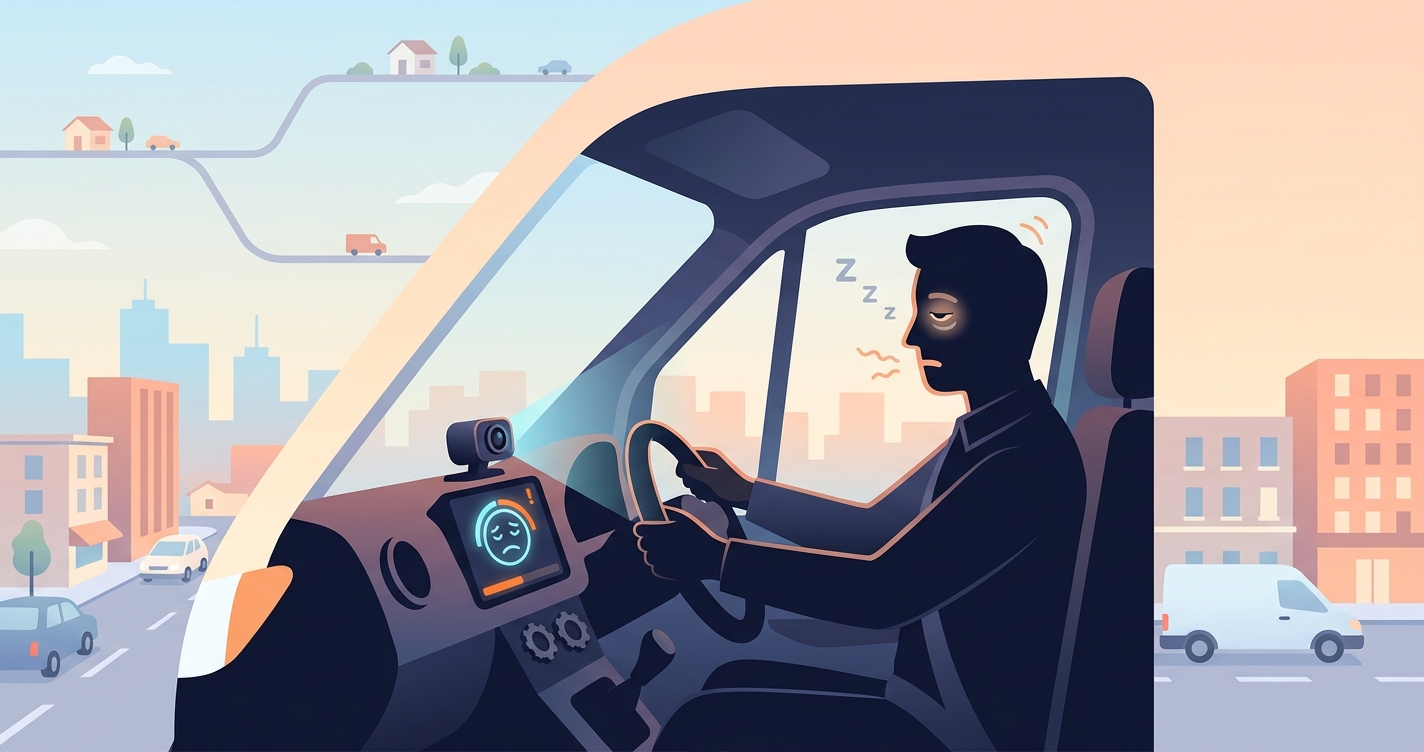
For fleet operators, DSPs, and logistics teams, last mile delivery driver fatigue detection has become a different problem from classic highway drowsiness. Parcel routes are shorter, but the workload is choppier: dense urban traffic, constant stop-start driving, curbside hazards, route changes, customer time windows, and pressure to finish one more drop before the shift runs long. That mix creates a fatigue pattern that is less about a single sleepy moment and more about cumulative overload that quietly degrades reaction time, attention, and decision-making.
"Both heart rate and skin conductance level significantly increased with each incremental increase in cognitive demand." — Bruce Mehler, Bryan Reimer, and Joseph F. Coughlin, MIT AgeLab, Human Factors (2012)
Last mile delivery driver fatigue detection starts with a different risk model
Long-haul fatigue and last-mile fatigue are related, but they are not the same thing. A highway program may focus on lane drift, prolonged eyelid closure, and late-night monotony. Last-mile delivery adds something messier: repeated cognitive switching. Drivers move from navigation to parking search to package handling to pedestrian scanning to app updates, often dozens or hundreds of times in a single shift.
That matters because fatigue in this setting often shows up as degraded alertness under stress rather than obvious sleep onset. MIT AgeLab researchers Bruce Mehler, Bryan Reimer, and Joseph F. Coughlin found in their 2012 on-road study that heart rate and skin conductance rose as cognitive demand increased across 108 drivers. For urban delivery fleets, that is a useful framing device. The problem is not only whether a driver is falling asleep. It is whether workload has pushed the driver into a state where errors become more likely.
The broader crash data still sets the stakes. The AAA Foundation for Traffic Safety reported in 2018 that drowsy driving was involved in 9.5% of all crashes and nearly 11% of higher-severity crashes. NHTSA separately reported 693 drowsy-driving deaths in 2022. Those numbers are not specific to parcel fleets, but they are a reminder that fatigue remains one of the most undercounted safety risks on the road.
Comparison of fatigue-detection approaches in last-mile delivery
| Approach | Main signals | Best fit for last-mile fleets | Main limitation | Typical outcome |
|---|---|---|---|---|
| Camera-based DMS | Eyelid closure, gaze, blink duration, head pose, distraction cues | Urban route monitoring with no driver action required | Can miss early physiological stress before visible behavior changes | Real-time in-cab warnings and event flags |
| Camera-based vitals + DMS | DMS signals plus heart rate or respiration proxies from facial video | Fleets that want earlier context on fatigue buildup | Signal quality depends on lighting, motion, and camera placement | Graded fatigue and stress alerts |
| Wearables | Heart rate, HRV, motion, skin temperature | Small pilots or specialized high-risk teams | Compliance, charging, loss, and driver adoption | Personalized readiness or fatigue scoring |
| Telematics-only rules | Harsh braking, speed variance, route time, stop density | Broad baseline monitoring across large fleets | Detects consequences later than causes | Supervisor review and coaching |
| Multimodal fusion | DMS, physiology, route context, shift duration, telematics | Mature safety programs with escalation workflows | More integration work | Earlier and more confident alerts |
The pattern is pretty straightforward. The closer a system gets to combining physiology, behavior, and route context, the better it handles last-mile fatigue as an operational problem instead of a single drowsiness label.
Why parcel and urban delivery fleets are hard to monitor
Last-mile operations create a strange contradiction. Drivers may not spend hours on empty roads, yet many routes are exhausting for exactly the opposite reason. They demand constant attention.
A 2022 global survey from Scandit found that 71% of delivery drivers reported increased delivery volumes and 66% said they were expected to work faster. CEO Samuel Mueller described a workforce stretched by rising parcel volume and tighter service expectations. That is not peer-reviewed physiology research, but it does help explain why fleet fatigue programs are shifting away from narrow "falling asleep at the wheel" logic. Urban delivery fatigue is often produced by time pressure, fragmentation, and accumulated task load.
There is also evidence that injury pressure is rising around parcel delivery work. A recent NEISS-Work analysis on parcel-delivery injuries found that emergency-department-treated injury rates for Postal Service and couriers/messengers trended upward from 2015 through 2022, even as broader U.S. industry injury rates moved down. That does not prove fatigue caused every injury. It does underline the fact that this workforce is operating in a more demanding environment.
For safety teams, that means a useful fatigue-detection model usually combines:
- time on route and time of day
- stop density and route complexity
- recent distraction indicators from in-cabin cameras
- physiological stress or fatigue proxies when available
- harsh-driving events that may signal declining alertness
- escalation rules that separate mild risk from urgent intervention
One metric alone rarely tells the truth.
Industry applications for last-mile delivery fleets
Parcel and DSP networks
Large parcel networks need systems that scale across hundreds or thousands of drivers. That usually favors camera-based detection because it does not depend on a wearable being charged, paired, or even accepted by the driver. The best programs use DMS to monitor blink duration, gaze direction, micro-distraction patterns, and head-pose changes while also bringing in route context such as delivery density and shift length.
Grocery and same-day delivery
These fleets often run tighter windows and more aggressive routing. Fatigue here can blend into stress. A driver may still look awake, but the quality of decisions starts slipping. That is where in-cabin vital-sign estimation becomes interesting. Remote photoplethysmography research by Wim Verkruysse, Lars O. Svaasand, and J. Stuart Nelson showed back in 2008 that pulse-related signals could be extracted from facial video using ambient light. In vehicle cabins, that opens the door to watching for changes in physiological state without adding another device.
Route-based field service fleets
Utilities, telecom service fleets, and similar mobile workforces share many last-mile characteristics even if they do not think of themselves as parcel operators. Their fatigue risk is often tied to repeated stops, cognitive switching, and long days that include both driving and physical work at each destination. For them, fatigue detection is as much about workload management as it is about road safety.
Current research and evidence
The evidence base is not built around one perfect biomarker. It is built around convergence.
First, the MIT AgeLab study by Mehler, Reimer, and Coughlin matters because it linked higher cognitive demand with measurable physiological change during real driving. That is useful for urban fleets where mental load is often the hidden variable.
Second, the 2022 systematic review "Detecting driver fatigue using heart rate variability" by Ke-Qian Lu, Anna Sjörs Dahlman, Johan Karlsson, and Stefan Candefjord found that HRV remains one of the more promising physiological approaches for driver-fatigue detection, even if results vary by study design and environment. That caveat matters. HRV is informative, but fleets should not expect a single threshold to work across every driver and route.
Third, a 2024 review by Mansoor S. Raza, Mohsin Murtaza, C. Chi-Tsun Cheng, Muhana M. A. Muslam, and B. Bader M. Albahlal looked at cognitive impairment in drivers through HRV-linked workload measures. Their review is a good reminder that fatigue detection is drifting toward broader state estimation: fatigue, stress, cognitive overload, and degraded readiness are starting to blur into one monitoring category.
Fourth, the foundation for camera-based vital-sign estimation still traces back to Verkruysse and colleagues' 2008 paper. For quick-delivery fleets, that is important because contactless sensing fits the operational reality better than asking every driver to wear one more device.
- Fatigue in last-mile delivery is often cumulative, not dramatic.
- Urban route stress can degrade performance before a driver looks obviously sleepy.
- DMS works best when paired with context, not treated as a standalone alarm.
- Physiology can sharpen detection, especially for early-stage fatigue buildup.
- Fleet response workflows matter as much as signal detection.
What a practical fatigue-detection stack looks like
A good last-mile fatigue program usually has three layers.
The first layer is continuous observation. That means in-cabin cameras, route telemetry, and shift context. The system needs to know what is happening now and what kind of route the driver is facing.
The second layer is state interpretation. This is where fleets combine blink metrics, gaze behavior, route duration, event history, and, increasingly, contactless physiology. A short burst of hard braking at 9 a.m. is not the same as repeated harsh events, longer blinks, and elevated stress proxies at the end of an overloaded shift.
The third layer is response design. Too many fatigue systems stop at detection. Useful ones decide whether the right action is an in-cab prompt, a break recommendation, route reassignment, supervisor notification, or post-shift coaching.
That sounds simple, but it is the difference between a dashboard and a safety system.
The future of last-mile delivery driver fatigue detection
The next phase will probably be less about adding sensors and more about reducing false confidence.
One shift is toward personal baselines. A dense downtown route may elevate one driver's heart rate all afternoon without signaling meaningful fatigue, while another driver's drop in HRV after six hours may be a more serious warning. Fleets will get better results when systems learn the driver's normal range instead of relying on one universal cutoff.
Another shift is toward multimodal scoring. A future parcel-fleet alert will likely combine route intensity, cumulative driving time, distraction trends, and contactless physiology rather than treating each data source separately.
A third shift is toward edge processing in the cabin. That matters for latency, cost, and privacy. Fleets do not always need raw video moving to the cloud. In many cases, they need event summaries and confidence scores that fit existing safety workflows.
This is where the market is heading. Last-mile operators are under pressure to move faster, but the safety model cannot just be "push harder and hope." Detection systems that can tell the difference between routine strain and real fatigue risk will be worth much more than systems that simply generate more alerts.
Frequently Asked Questions
Why is last-mile delivery fatigue different from long-haul fatigue?
Long-haul fatigue often builds through monotony, night driving, and time-on-task. Last-mile fatigue is more fragmented. It comes from stop-start driving, dense traffic, repeated decision-making, time pressure, and physical task switching throughout the route.
What signals help detect fatigue in parcel delivery fleets?
The most useful signals are usually a combination of eyelid behavior, blink duration, gaze stability, head pose, shift length, route density, harsh-driving events, and, when available, physiological measures such as heart-rate or HRV-related proxies.
Are wearables the best option for delivery-driver fatigue detection?
Not always. Wearables can provide rich physiological data, but large fleets often struggle with charging, compliance, and device management. Camera-based systems are easier to scale because they work in the vehicle without requiring driver setup.
Can camera systems detect fatigue before a driver looks sleepy?
Sometimes, especially when they include contactless physiology or are combined with route context and behavioral trends. The goal is not just to catch visible drowsiness. It is to identify the buildup toward degraded performance earlier.
Solutions like Circadify are part of that shift toward contactless in-cabin sensing for fleet and automotive programs. For related analysis, see Driver Fatigue Detection: How Camera Technology Prevents Accidents and How Fleet Operators Use Driver Health Monitoring Systems.