5 Driver Monitoring KPIs Every Fleet Safety Manager Should Track
A research-based look at driver monitoring KPIs fleet safety manager teams can use to connect distraction, fatigue, and intervention data to real fleet risk.
5 Driver Monitoring KPIs Every Fleet Safety Manager Should Track
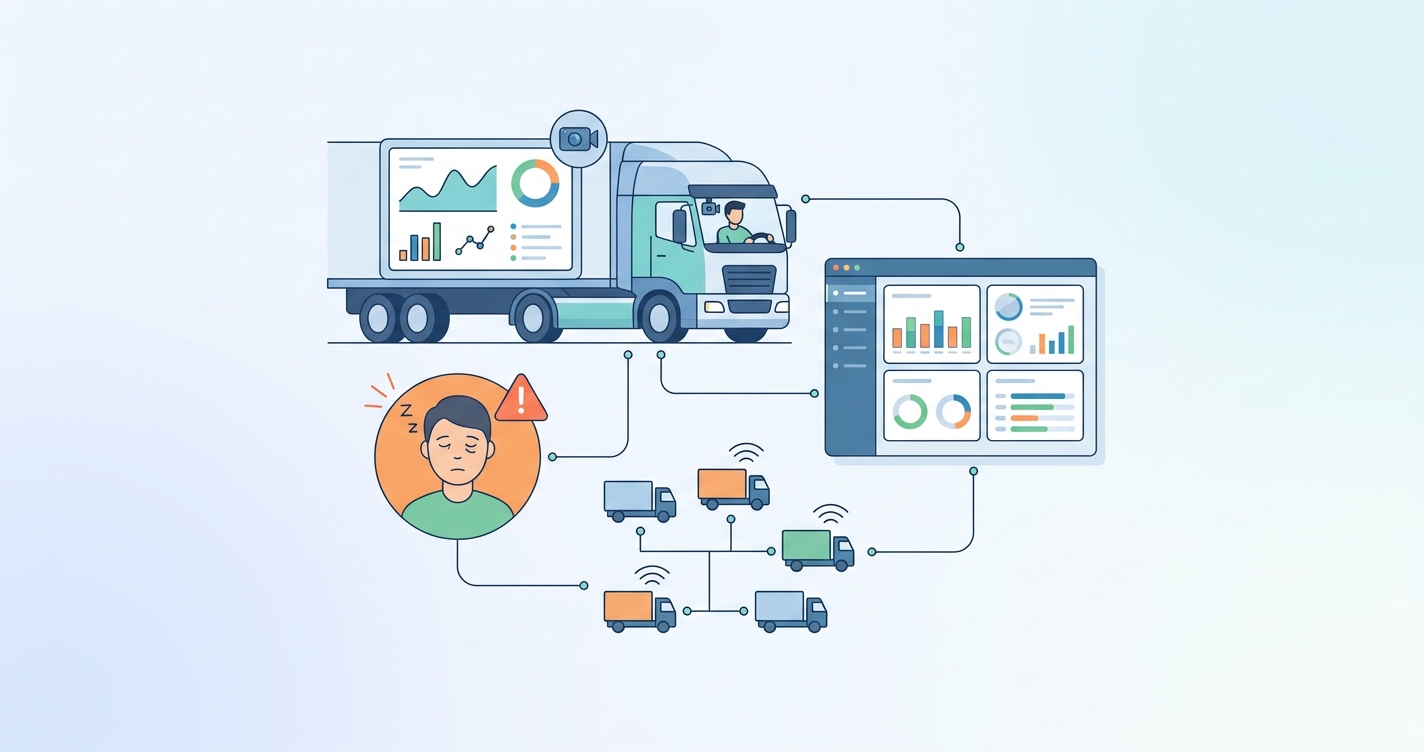
For commercial fleets, driver monitoring KPIs fleet safety manager teams care about have moved well beyond simple harsh-braking counts. The real question is whether a fleet can measure the moments that happen before a crash, a claim, or a disciplinary review: eyes off road, slow response to alerts, repeated fatigue markers, and the gap between a warning and a corrective action. Those are the signals that tell you whether a driver monitoring program is producing safer behavior or just generating more video.
Brian Tefft of the AAA Foundation for Traffic Safety reported in 2018 that drivers who slept for less than four hours in the previous 24 hours had crash involvement rates comparable to drivers at the legal alcohol limit.
The driver monitoring KPIs that matter in fleet operations
A fleet program usually starts with cameras, telematics, and event review. That is the easy part. The harder part is deciding which measurements actually tell you something useful. A dashboard with 40 charts can still miss the basic point. Fleet safety managers need a short set of KPIs that link driver state to operational risk.
The five metrics below show up again and again in commercial safety research, regulation, and program design.
- distracted-driving event rate
- fatigue or drowsiness alert rate
- unacknowledged alert rate
- time-to-correction after a monitoring alert
- repeat high-risk driver exposure
These are not the only numbers worth collecting, but they give a much cleaner picture of whether the system is reducing preventable risk.
| KPI | What it measures | Why fleet teams use it | What a rising value may mean |
|---|---|---|---|
| Distracted-driving event rate | Driver-facing camera detections of gaze diversion, device use, or prolonged inattention per 1,000 miles or hours | Shows how often attention drifts before a roadway event | Route pressure, poor policy enforcement, weak coaching follow-through |
| Fatigue or drowsiness alert rate | Eyelid closure, head pose, microsleep markers, or fatigue classifications over time | Helps identify sleep-related risk patterns by driver, route, and shift | Night-shift exposure, scheduling problems, long-haul fatigue buildup |
| Unacknowledged alert rate | Share of alerts that receive no visible driver response | Indicates whether alerts are audible, timely, and behavior-changing | Driver overload, poor HMI design, alert fatigue |
| Time-to-correction | Seconds from alert to visible corrective behavior such as eyes back on road or posture reset | Measures whether interventions produce fast recovery | Late alerts, unclear warning design, low driver engagement |
| Repeat high-risk driver exposure | Number of drivers or trips with recurrent high-severity events over a defined period | Separates one-off incidents from chronic risk concentration | Need for coaching, scheduling review, or deeper medical/wellness follow-up |
Why KPI design has shifted from vehicle behavior to driver state
Fleet safety programs used to rely heavily on vehicle-outcome metrics. Speeding, hard braking, and collisions still matter, obviously. But they are lagging indicators. By the time those numbers move, the unsafe behavior has already happened.
That is why driver-state monitoring is getting more attention in both research and policy. NHTSA's 2023 distracted-driving research note found that 3,275 people were killed in crashes involving distracted drivers in the United States, accounting for 8% of all traffic fatalities that year. For a fleet manager, that number is not just background context. It is a reminder that attention failures are common, measurable, and expensive long before they appear in claims data.
The same pattern shows up in fatigue research. Tefft's AAA Foundation analysis did not treat sleep loss as a soft wellness issue. It treated it as a crash-risk multiplier. That is a useful framing for fleets because fatigue KPIs should sit in the safety stack, not off to the side as an HR topic.
I keep coming back to this point: the best KPI set is not the one with the most data. It is the one that tells a manager when driver condition is starting to drift into operational risk.
Five KPIs in practice
1. Distracted-driving event rate
This is usually the foundation metric. It counts attention-related events per normalized exposure, often per 1,000 miles, 100 driving hours, or 100 trips. The exact denominator matters less than consistency across the fleet.
Rebecca Olson, Richard Hanowski, Jeffrey Hickman, and Jonathan Bocanegra examined commercial motor vehicle distraction in a landmark FMCSA naturalistic driving study. Their work helped establish that some distraction types sharply increase crash and near-crash risk, especially when they pull the driver's eyes away from the forward roadway. That is why event rate belongs on the top line of any DMS program.
Useful cut views include:
- by route type
- by time of day
- by vehicle class
- by new-hire versus experienced driver cohort
- by coached versus uncoached driver group
2. Fatigue or drowsiness alert rate
This KPI captures how often the system detects fatigue-linked patterns such as prolonged eye closure, head nodding, low vigilance, or repeated drowsiness classifications. It is more valuable when broken out by shift window and trip duration.
A flat fleetwide average can hide the real issue. One depot may look normal overall while overnight line-haul trips are producing repeated fatigue alerts in the last two hours of a route. That is a scheduling problem disguised as a technology metric.
The EU's General Safety Regulation 2019/2144 moved this conversation further into the mainstream by requiring driver drowsiness and attention warning systems on new vehicle categories. That does not mean every fleet has the same operational requirements, but it does show where the industry is heading: fatigue detection is becoming standard safety infrastructure, not an experimental add-on.
3. Unacknowledged alert rate
This is one of the most underrated KPIs in driver monitoring.
A camera can correctly identify a risky state and still fail operationally if the driver does not respond. Unacknowledged alerts often point to problems that a raw detection count will miss. Maybe the warnings are too frequent. Maybe they come too late. Maybe the cab environment is noisy enough that drivers tune them out.
For fleet safety managers, this KPI helps answer a practical question: are alerts changing behavior in the cab, or just populating review queues after the fact?
4. Time-to-correction after an alert
Time-to-correction tracks how quickly a driver returns to safer behavior after a distraction or fatigue warning. Depending on the system, correction might mean eyes back on road, head pose normalized, posture adjusted, or hands returned to active control.
This metric matters because two fleets can log the same number of alerts and have very different risk profiles. In one fleet, drivers correct within a second or two. In another, the same warnings linger while the unsafe state continues. That difference tells you a lot about alert quality, training, and trust in the system.
This is also where the fleet conversation starts to overlap with automotive HMI research. If warning design is weak, response time stretches out. If alerts are clear and timed well, corrective behavior tends to appear sooner.
5. Repeat high-risk driver exposure
Not every event carries the same meaning. One distraction alert in a month may not mean much. Fifteen high-severity alerts across similar route conditions usually mean something is structurally wrong.
A repeat exposure KPI tracks drivers, trips, or route segments that accumulate recurring high-risk events over a defined period. This is the number that tells managers where to focus coaching, scheduling changes, supervisor review, and in some cases broader health or fatigue interventions.
Without it, fleets often spread their attention too evenly. With it, they can prioritize the small slice of operations where risk is actually concentrated.
Industry applications for fleet KPI programs
Long-haul and overnight freight
These operations care most about fatigue clustering, late-shift alert response, and repeated exposure on monotonous routes. Drowsiness alert rate and time-to-correction usually tell a more useful story here than simple speeding counts.
Last-mile and urban delivery
Urban delivery programs tend to produce a different risk mix: frequent distractions, device interaction, and dense stop-start conditions. Distracted-driving event rate and unacknowledged alerts become more important because attention is constantly being pulled in multiple directions.
Transit and passenger transport
Passenger operators need proof that the monitoring stack supports intervention before a visible safety incident. In those programs, repeat high-risk exposure matters because a small group of drivers can create a disproportionate share of operational complaints and incident reviews.
Current research and evidence
The evidence behind these KPIs comes from different corners of the safety world, but it points in the same direction.
Tefft's 2018 AAA Foundation study linked short sleep duration to sharply higher crash risk, giving fatigue metrics a concrete safety rationale instead of a vague wellness framing. NHTSA's 2023 distracted-driving note did the same for attention failures by tying them to a measurable national fatality burden.
Commercial fleet research adds another layer. Olson, Hanowski, Hickman, and Bocanegra's FMCSA work used naturalistic driving data to show that specific distraction behaviors are not all equal; some create much higher crash and near-crash exposure than others. That matters because a good KPI program should weight severe attention failures differently from minor glance events.
Regulation is pushing in the same direction. The EU's 2019/2144 framework made driver drowsiness and attention warning part of the modern vehicle safety baseline. Even where regulation does not dictate a fleet dashboard, it changes buyer expectations. OEMs, Tier-1 suppliers, and fleet operators increasingly treat driver-state data as a standard safety input.
Selected evidence behind fleet driver monitoring KPIs
| Source | Institution | What it contributes to KPI design |
|---|---|---|
| Brian Tefft (2018), "Acute Sleep Deprivation and Risk of Motor Vehicle Crash Involvement" | AAA Foundation for Traffic Safety | Supports fatigue-alert and fatigue-exposure KPIs by linking low sleep to much higher crash risk |
| Olson, Hanowski, Hickman, and Bocanegra, FMCSA naturalistic driving study | FMCSA / Virginia Tech Transportation Institute | Supports distraction-event and severity-weighted risk KPIs in commercial fleets |
| NHTSA Research Note: Distracted Driving in 2023 | U.S. DOT / NHTSA | Supports monitoring attention-related event burden as a core fleet safety metric |
| Regulation (EU) 2019/2144 | European Union | Confirms drowsiness and attention warning as part of the modern safety baseline |
The future of driver monitoring KPIs in fleet safety
The next step is not just more sensing. It is better operational interpretation.
Fleet teams are starting to ask harder questions: Which alerts predict claims? Which route patterns produce the most unresolved fatigue exposure? Which coaching interventions shorten time-to-correction? Which depots improve after schedule changes, and which do not?
That is where driver monitoring gets more useful. A mature program does not stop at detection. It ties detection to response quality, repeat exposure, and business outcomes.
I do not think fleets need endless KPIs. They need a small set that can survive executive review, insurance review, and safety-manager reality. If a metric does not help explain risk concentration or guide intervention, it probably does not deserve dashboard space.
Frequently Asked Questions
What is the most important KPI in a driver monitoring program?
There is not a single universal winner, but distracted-driving event rate is usually the anchor metric because it captures frequent, measurable attention failures across many fleet types.
Why is unacknowledged alert rate so important?
Because a technically accurate alert still fails if the driver does not respond. This KPI shows whether the system is influencing behavior in real time.
Should fleets track fatigue separately from distraction?
Yes. Fatigue and distraction often overlap, but they do not behave the same way operationally. Fatigue tends to cluster around schedule design, trip duration, and time of day.
How often should fleet safety managers review these KPIs?
Most fleets need weekly operational review and monthly trend analysis. That balance is frequent enough to catch emerging problems without overreacting to random variation.
For automotive and fleet teams building more advanced in-cabin monitoring stacks, solutions like Circadify are being developed for programs that connect driver state, vital signs, and alert workflows inside the cabin. For more on that direction, see Circadify's automotive cabin page, plus related Quick Scan Vitals coverage on fleet driver health monitoring systems and driver health analytics and actionable alerts.